LIFF
Lebanese Independent Film Festival المهرجان اللبناني للأفلام المستقلة
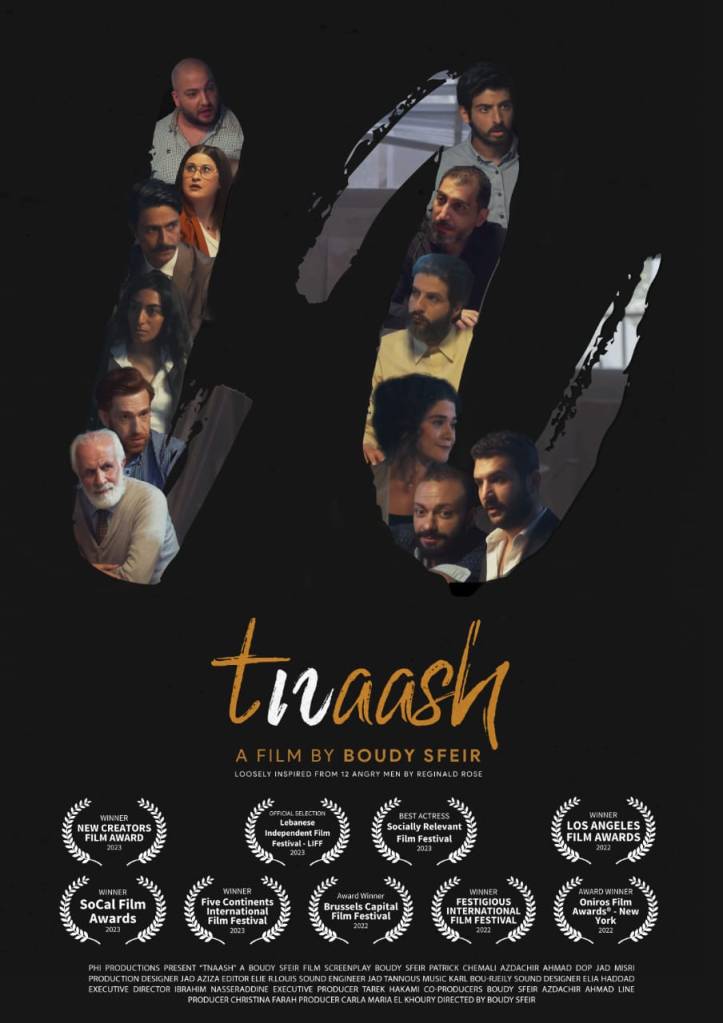
Tnaash Film Premiere
Tnaash screening on Sunday September 24th from 7:30 pm – 9:30 pm in the presence of the director and followed by a Q and A.
Synopsis
After the August 4th Beirut Port explosion a judicial reform brings about the first trial by jury in Lebanon where 12 citizens are about to decide the fate of an illegal Syrian refugee accused of brutally killing a social activist known for helping the damaged community after the blast, but will they be able to put aside their pre-existing issues to offer an impartial verdict?
Director Biography – Boudy Sfeir
Boudy Sfeir is a Lebanese movie director, screenwriter, and animator.
Because most films in Lebanon are made by independent filmmakers, Sfeir strived for years to make his debut. Hence, in 2014, his first feature movie was released. It is a psychological thriller about a village whose residents believe in magic and supernatural powers. It also tackles the role of the media in giving recognition to exorcists and clairvoyants, and
creating propaganda.
In 2017, he wrote, directed, and animated his second film. He switched to a different genre this time. It is a family comedy that tells the story of a famous, fabled character in Beirut, in an imaginary sequence of events.
In early 2018, Sfeir released his third film. It is a comedy about a groom who finds himself in trouble after engaging in cybersex a day prior to his wedding.
Sfeir writes scripts almost on daily basis, and creates new concepts to enrich Lebanese cinema and TV drama. Though he faced many obstacles, he did never surrender. He kept walking as he believes that there is noplace for weak people in the film industry, and that success needs time and patience to be achieved. Therefore, he insisted to create a fourth
cinematic work. Inspired by the Lebanese social and political atmosphere, “Tnaash” is born.
Director Statement
I have always been thinking what would a group of Lebanese people, from different sectarian and political backgrounds, do when they are stuck in a situation where they have to take a unified decision. Would they be objective even for once?
As per this personal question, we came up with a script that fictionally tells about an imaginary judicial reform that took place just after the 4th of August traumatic incident (The port’s blast). Hence, a jury of ordinary men and women have to decide whether an accused Syrian refugee is guilty or not.
The location was meticulously chosen to be symbolic. It’s a room inside the national electricity company, and the production design has portrayed a mood which resembles the miserable situation in Lebanon.
Lighting and camera movement convey symbolic realism. We have let the camera create a feeling of voyeurism, and simultaneously interacting with the action by using the snap zoom technique.
The camera follows the actors as if they are the controllers of the camera. However, the movement stops at certain moments and lets the actor/s express (es) freely.
The fast-rate editing vitally serves the suspenseful conversations and spontaneous reactions among the characters.
Music and sound effects play a substantial role in adding realism to the motion picture. For instance, the sound of the street and that of the military aviation is actually a reflection of a country that is open to all kinds of transgression.
This film highlights HOPE though the people of Lebanon are responsible, in a way or another, for the mess that their country is in. They should realize their fault.
Maybe we still have a chance. Maybe we still have hope.
Reserve your seat here!
Entrance Fee at the door (5$) All-day pass Festival.
 LIFF
LIFF 
